About the inscenation
L’éveil de la Montagne (The Awakening of the Mountain)
A musical and choreographic performance by the Taiwanese company U-Theatre at the Hybernia Theatre.
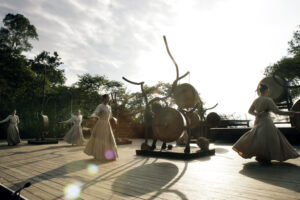
This is an exceptionally beautiful performance that combines musical virtuosity, traditional percussion, martial arts, dance and meditation. The company was founded in 1988 by Ms Liu Ruo-Yu and is internationally renowned. Since 1993, percussionist and artistic director Huang Chih-Chun has incorporated meditation into the company’s work, and the performers are trained in tai chi chuan. The ensemble is based in the hills of Taipei, which provide an ideal environment for concentration, discipline and awareness. ‘Awakening of the Mountain’ is an ode to the surrounding natural landscape, where their training centre is located on Mount Laoquan.
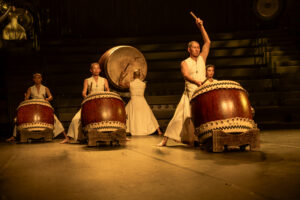
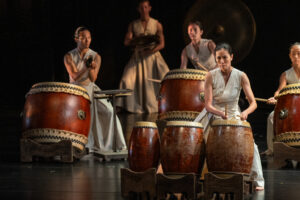
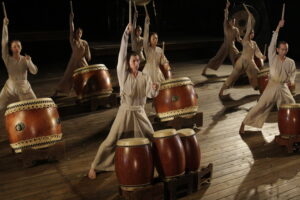
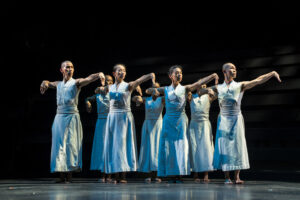
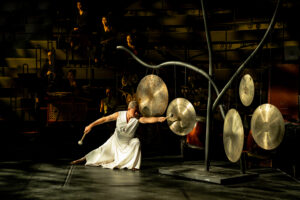
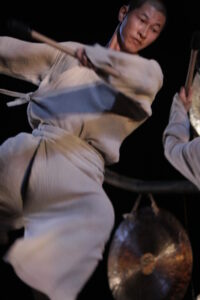
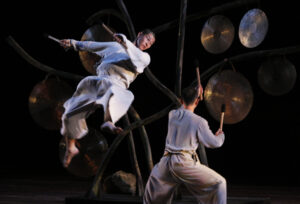
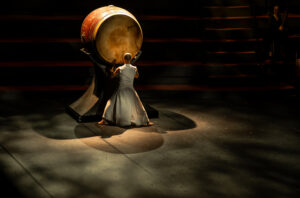
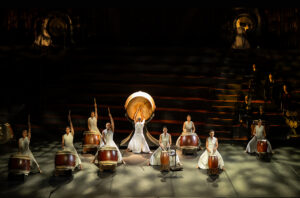
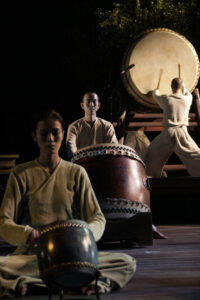
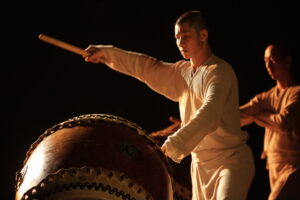
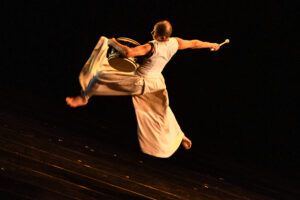
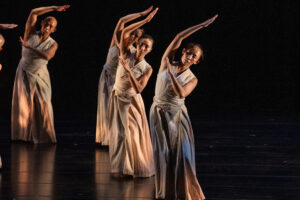
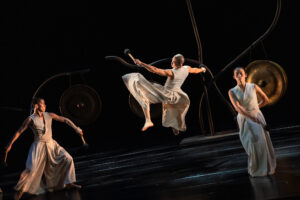
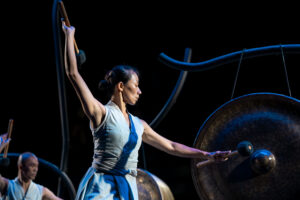
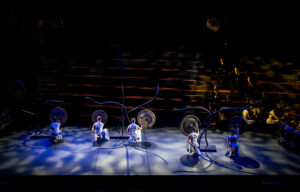
Musical instruments – primarily drums and gongs, some of which are small and hung from trees as decorations – create a visually striking set design. The performers appear barefoot and in long, elegant white tunics. The arrangement of the drums, which are moved on castors during the performance, has a choreographic quality in itself, as do the ritualised strikes with drumsticks whilst the arms are raised. High up on the stands opposite the audience are gongs, whilst on the right-hand side of the stage solo musicians perform – on the xiao, the Chinese two-stringed fiddle (erhu), the sheng, the yangqin, cello, flute, along with drums and gongs – all dressed in black, creating a perfect counterpoint to the drums. The ensemble ensures a balanced representation of women and men. The largest drum, the so-called ‘master drum’, is played by a man with his back to the audience, which requires considerable physical strength. The drumbeats, as if emanating from the mountain, are exceptionally precise – whether struck on the drumhead or the wood, producing various sounds of clicking, cracking or rhythmic footsteps. The drummers engage in a dynamic and controlled dialogue through choreographed movement. At times, they muffle the sound with their hands. The audience hears nature and senses the mountain – both calm and stormy. Occasionally, a dancer breaks away for a brief solo; at other times, the group forms patterns and moves in unison, their arms and bodies conveying symbolic gestures. Between symmetry and asymmetry, crescendo and decrescendo, nothing is left to chance; everything is perfectly mastered, their hands fluttering like butterflies.
The delicately crafted light holds the secrets of nature. The shadows of instruments, arms and wooden mallets are cast onto the walls; the comings and goings take on the appearance of sculptural compositions. Cries, running, building tension, sudden descents and whirling dances reminiscent of dervishes create a sense of spatial depth, enhanced by the diagonal composition and blue light.
The musicians kneel on the floor with their backs to the audience and strike the gongs. Like a ritual, *Awakening of the Mountain* unfolds a dense structure of gestures and sounds. The performance is imbued with concentration, emotion, a dialogue between drums, mysticism and transcendence. The flute and oboe seem to address the mountain or the sky. The music precisely shapes the space, the hands tell stories and sweeping arm gestures trace the horizon.
The choreography is meticulously constructed. Body, rhythm and breath unite physicality and spirit in an expression of extraordinary intensity and delicacy, evoking the first light of day and the cycle of life on Mount Laoquan. The work combines the rhythmic power of drums and gongs with the visual poetry of movement and choreography.
Adapted from a text by Brigitte Rémer.
Featuring dancers and musicians from the U-Theater ensemble
Dancers: Chih-Chun Huang, Yu-Xuan Su, Ya-Lun Chang, Kui-Lan Ou, Ching-Fang Hsu, Ping-Tsen Liu, Shu-Chih Liu, Ching-Sheng Lin, Chun-Tsung Chou, Hua-Yung Ou
Musicians: Ying-Ti Huang, Ya-Chi Wang, Nien-Tzu Hung, Hsi-Yen Lo, Yu-Hung Hsu
Lighting designer: Lulu Lee
Stage manager: Dun-gen Liao
Sound engineer: Ting-Kai Lin
Production manager: Yi-Shan Lai
Dates
Photogallery